Why Stretching Your Tight Hamstrings Might Be Making Things Worse
A Postural Restoration perspective on chronic hamstring tightness — and what to do instead.
If you’ve been stretching your hamstrings for months — maybe years — and they still feel tight, I have news for you: stretching might not be the soultion, it may be part of the problem!
In fact, in many cases, tight hamstrings are doing exactly what they’re supposed to do. They’re protecting you. And stretching them is working against that.
Let me explain.
The Real Reason Your Hamstrings Feel Tight
To understand what’s happening, we need to talk about your pelvis.
When your pelvis tips forward — a position called an anterior pelvic tilt — your hamstrings, which attach to the bottom of your pelvis (the sit bones), are lengthened. They’re already in a stretched position just from the way your pelvis is positioned.
Here’s the key: your hamstrings sense that stretch, and they respond by contracting to pull the pelvis back into a more upright position. They’re not short and overactive. They’re long and working hard — fighting to bring your pelvis back to a neutral position.
That constant low-level contraction is what you feel as tightness.
Key insight: Tight hamstrings are often not short — they’re long and working overtime. Stretching a muscle that’s already being over-lengthened doesn’t make it relax. It makes the problem worse.
Why Stretching Gives You Temporary Relief — But Not Lasting Change
When you stretch your hamstrings, you do get short-term relief. The muscle spindles temporarily reduce their firing, and the tension eases. That’s real — but it’s not fixing anything.
As soon as you stand up and start moving again, your body senses the forward tilt of the pelvis and the already lengthened hamstrings, and they contract right back to where they were. Sometimes within minutes.
This is why so many people stretch faithfully for years and never actually fix their hamstring tightness. The root cause — the anterior pelvic tilt and the muscles that allow it — hasn’t been addressed.
What This Has to Do With Postural Restoration (PRI)
This is one of the foundational concepts taught by the Postural Restoration Institute (PRI), founded by Ron Hruska, PT, MPA. PRI looks at the body as an integrated system — not a collection of individual muscles to stretch or strengthen in isolation.
According to PRI principles, the hamstrings work together with the abdominal obliques, the transversus abdominis, and the diaphragm to position and control the movement of the pelvis. When that system is working well, the pelvis can move into a neutral position at rest, the hamstrings aren’t overloaded, and movement feels easy.
When the system breaks down — the hamstrings have to compensate. And that’s when the chronic tightness begins.
What to Do Instead: The 90-90 Hip Lift
Rather than stretching the hamstrings, the goal is to retrain the entire system — specifically activating the hamstrings, abdominal obliques, transversus abdominis, and diaphragm together to restore a neutral pelvic position.
One of the most effective starting-point exercises for this is the 90-90 Hip Lift, a foundational PRI exercise.
How to do it:
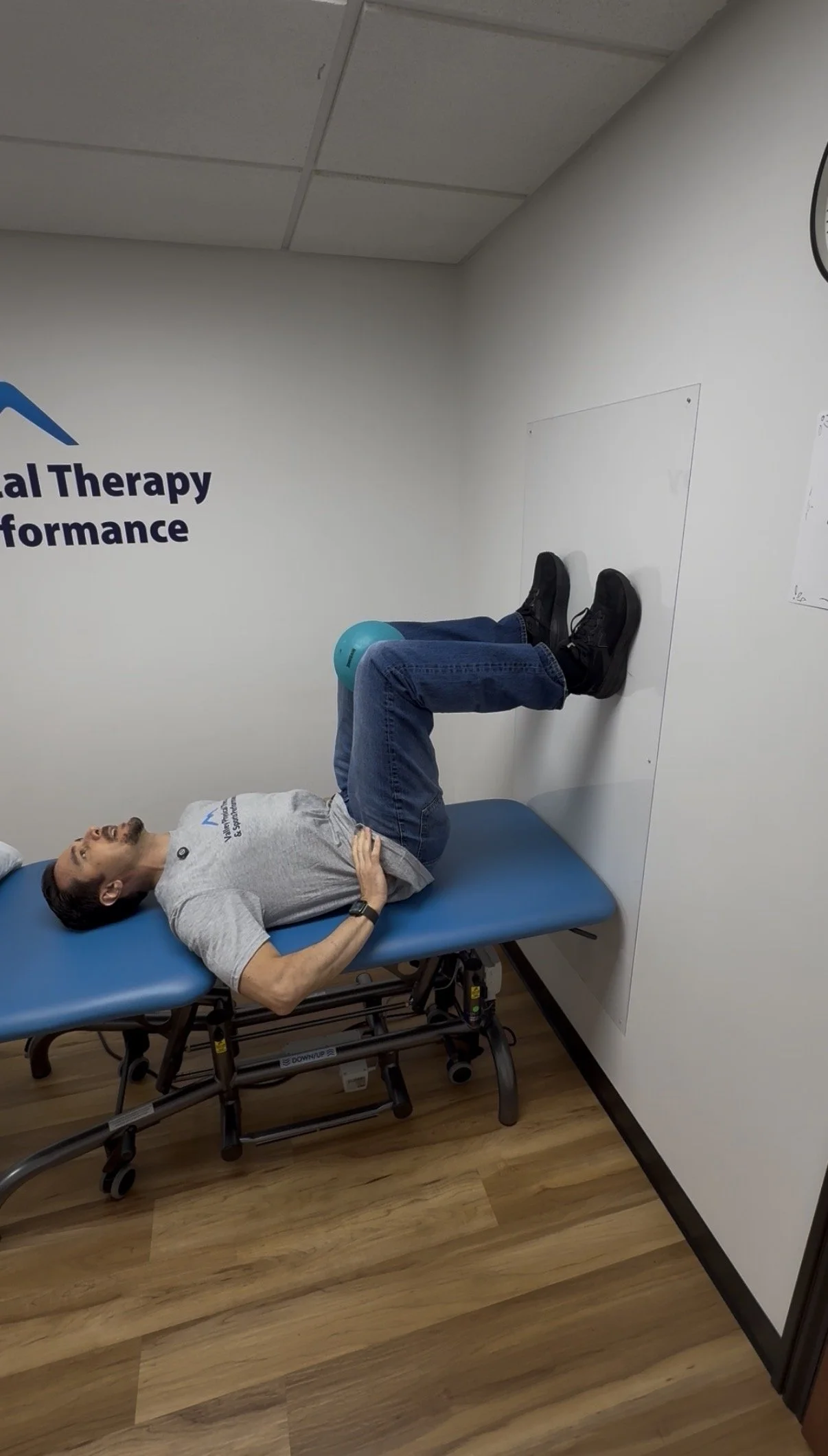
1. Lie on your back with your hips and knees bent at a 90 degree angle with your feet resting flat against a wall.
2. Place a small ball or folded towel between your knees and gently squeeze to activate your inner thigh muscles.
3. Take a deep breath in through your nose. As you exhale through your mouth slowly, flatten your low back into the floor by curling your tailbone up slightly — this is your hamstrings and abdominals working together.
4. Hold this position (pelvic tilt) as you inhale through your nose and exhale through your mouth. Don’t forget to pause for 5 seconds after each exhalation.
5. Do four sets of 4 breaths. The goal is a full, relaxed exhale with your low back flat — not a forced crunch.
Watch the full demonstration here: 90-90 hip lift
Done correctly, you’ll feel your hamstrings working in a way that’s very different from stretching — a gentle, productive engagement rather than a pull. Over time, consistently training this movement helps the pelvis find neutral, and the chronic tightness begins to ease for a lasting change.
⚠️ Important: This exercise is a starting point and works well for many people, but chronic tightness can have multiple causes. If you’ve been dealing with this for a long time or have associated hip, back, or knee pain, a one-on-one evaluation will give you a much clearer picture of what’s driving your specific problem.
Ready to Find the Root Cause?
At Valley PT & Sports Performance, every session is one-on-one and built around you. We don’t just treat the symptoms — we find out why your body is doing what it’s doing and build a plan that creates lasting change.
If you’ve been stuck in the stretch-and-repeat cycle with no real improvement, we’d love to help.
💻 Book a session: valleyptandsport.com | 📍 Harrisonburg, Virginia