How Your Ribs, Pelvis, and Gait Are All Connected (And Why "Out of Place" Isn't the Real Problem)
Quick Recap
In our last post, we talked about how pelvic and rib movement are coupled during breathing. If you haven't read that one yet, go check it out first — this post builds directly on it. You can find that post here!
Here's a quick refresher: when the pelvis moves into an anterior tilt, the front of the ribs rotate upward toward the head, increasing the volume of the thorax. This is a position of inhalation. As the pelvis moves backward into a posterior tilt, the front ribs rotate downward. This is a position of exhalation.
That's the full picture at rest. But to really understand how this affects your posture and the way you walk, we need to look at what's happening on each side of your body during gait.
Breathing and Gait Are Linked Too
While you're walking, each side of your pelvis is doing the opposite motion — which means each side of your rib cage is doing the opposite motion too.
Let's break this down. Picture yourself standing on your right leg and taking a step forward with your left (right stance phase, left swing phase). When you're standing on your right leg, your right pelvis moves into a posteriorly rotated position, allowing proper weight-bearing directly through the hip joint. At the same time, your left pelvis moves into an anteriorly rotated position to help swing your leg forward. When your left foot hits the ground and your right leg pushes off, the positions switch: your right pelvis moves into an anterior tilt, and your left pelvis moves into a posterior tilt.
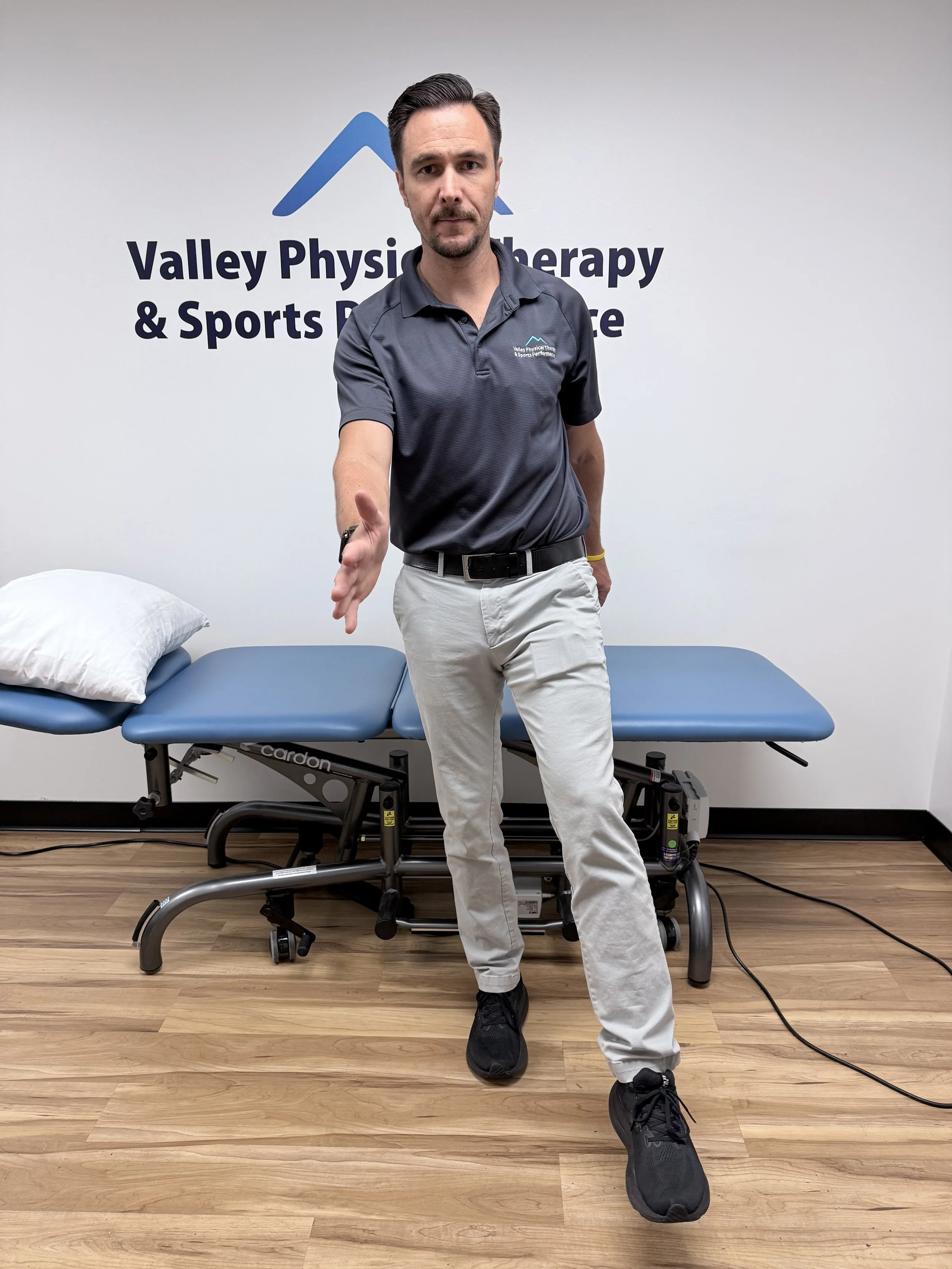
Right stance phase of gait: notice how the pelvis is turned toward the right leg and the trunk is turned to the left.
Rib and Pelvis Motion During Walking
Now let's apply the breathing mechanics from last post to this. As the pelvis rotates forward, the ribs rotate up and out in front — the inhalation phase. As the pelvis rotates backward, the ribs move down and in — the exhalation phase.
If you're following the logic, you can probably guess what's coming: each side of your rib cage is doing the opposite movement during gait, matching the opposite movement happening at the pelvis.
Putting it together: during right stance phase, the right pelvis is rotated posteriorly and the right ribs are rotated downward and inward in front. At the exact same moment, the left side of the body is in swing phase — the left pelvis is anteriorly rotated and the left ribs are moving upward and outward in front.
Right leg down, right pelvis back, right ribs down and in. Left leg swinging, left pelvis forward, left ribs up and out. Can you picture it?
Add In Trunk Rotation
There's one more piece to this puzzle: rotation through the pelvis and trunk, and those movements oppose each other too.
In our right stance phase example, the pelvis rotates to the right while the trunk rotates to the left. This opposite rotation is exactly what allows the classic opposite arm/opposite leg pattern of walking — you step with your left leg and reach with your right arm.
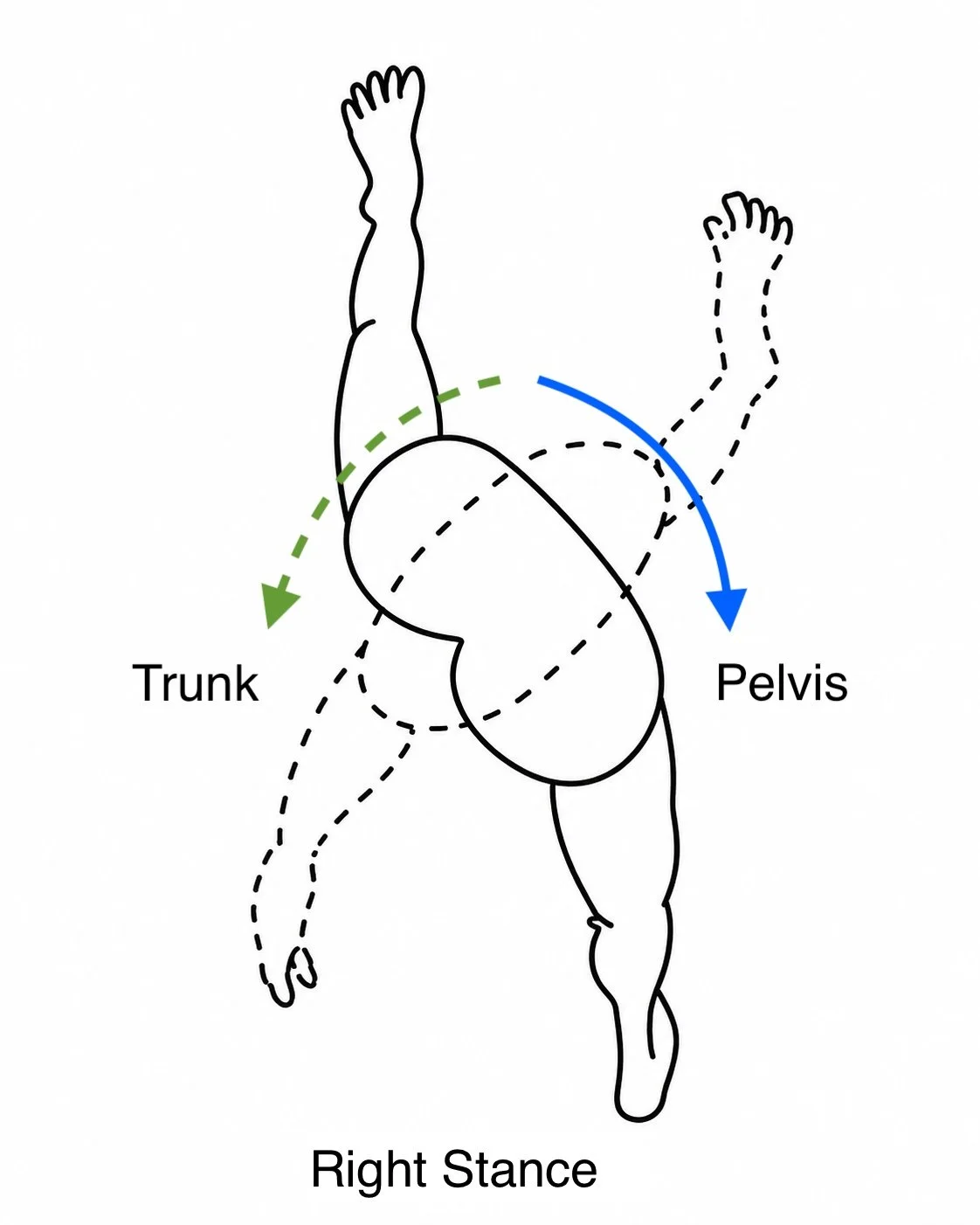
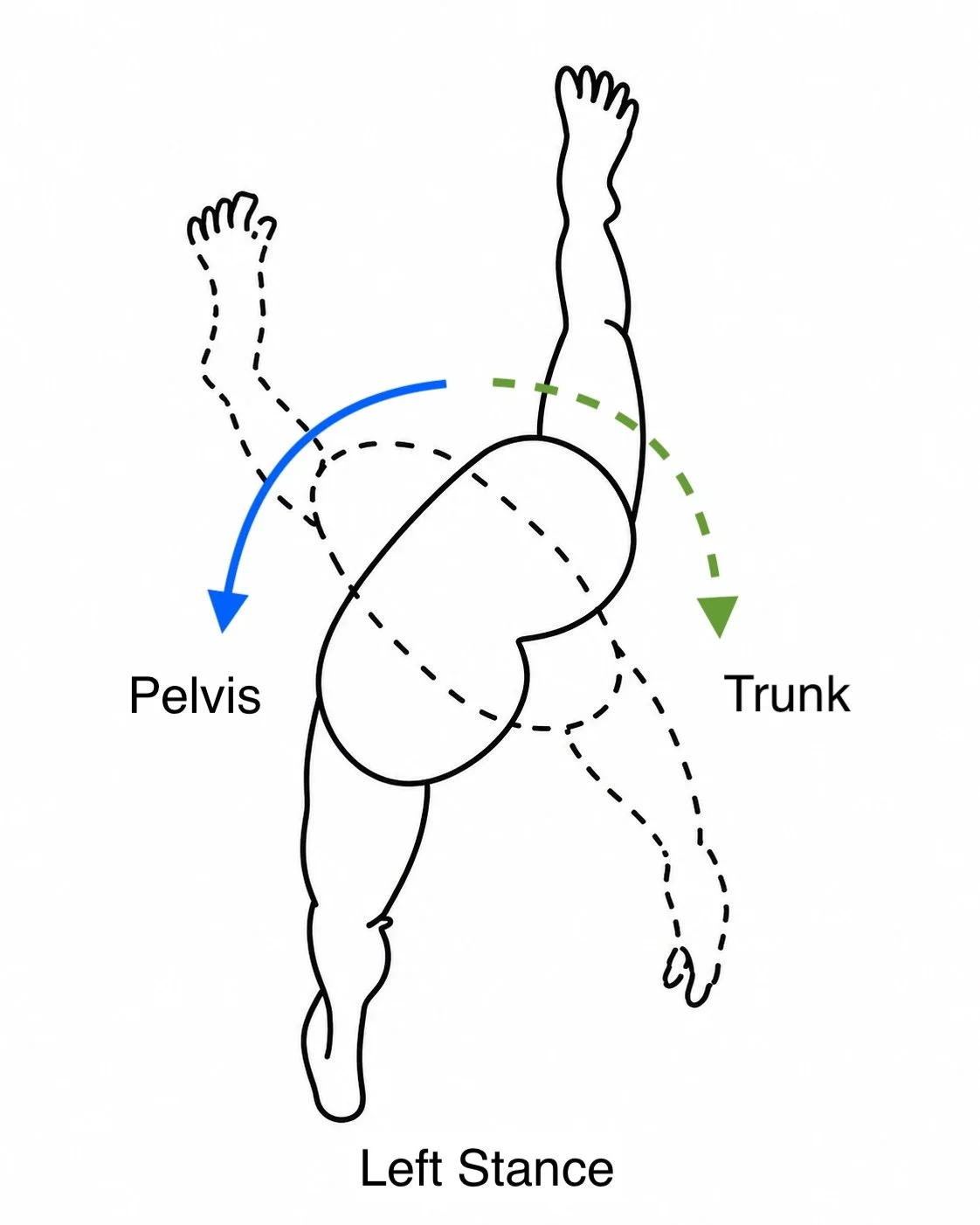
So during right stance phase: the pelvis turns right, the right half of the pelvis rotates backward, and the front ribs on the right rotate downward and inward. On the left, the opposite happens — the pelvis rotates forward and the ribs rotate upward and outward. The net effect is the trunk bending slightly to the right, with the right side compressing and the left side expanding.
What We See in the Clinic
Here's why this matters: in our clinic, we frequently see people who are noticeably better at stance phase on one side of the body and swing phase on the other. What that tends to look like from the outside is a trunk bent to one side, an unlevel pelvis, a lower shoulder, and ribs flared out more on one side than the other.
The big issue is that these patients have often been told their ribs and pelvis are "out of place," with treatment aimed at putting them back in place. Here's the problem with that approach: they're not out of place. The body simply prefers one half of the gait cycle over the other, and that preference is a learned pattern in the brain.
It's Not "Out of Place" — It's a Preference
Putting things back in place manually is only a temporary fix, because the body naturally returns to the movement patterns it already knows. For lasting change, we have to address this at the level it actually lives: the brain. We need to retrain the brain and body to move more symmetrically, not just force a joint back into position.
It's no coincidence that the pattern we just described — a preference for right stance phase and left swing phase — corresponds exactly to the Left Anterior Interior Chain (Left AIC) and Right Brachial Chain (Right BC) patterns described by the Postural Restoration Institute. We commonly see overactivity in these muscle chains in our clinic. Even at rest, these muscles are more active than their counterparts on the opposite side, holding the ribs and pelvis in that same asymmetrical position — favoring right stance and left swing — all day long.
How PRI Treatment Addresses This
Once we understand what's actually driving the pattern, treatment developed by the Postural Restoration Institute focuses on breathing retraining and targeted muscle activation to restore normal breathing mechanics and normal pelvic mechanics on each side of the body. These techniques tie together the rib cage and pelvic movements needed for optimal stance and swing phases on both sides — not just correcting the dominant side, but building up the side the body has been avoiding.
Wrapping Up
If you've been told your hips or pelvis are out of place, that there's twisting or torque through your spine, or you've noticed asymmetries in your body that haven't changed with traditional treatment, you're not alone. We see this constantly, and the frustrating part is that people are often still dealing with pain and difficulty with their activities despite treatment.
The good news: this is exactly the kind of pattern we recognize and work with at Valley Physical Therapy and Sports Performance, and the techniques we use are designed to create lasting change, not just temporary relief.
If this sounds like something you or someone you know has been dealing with, we're here to help. Schedule a discovery visit (https://valleypt.janeapp.com) and let's finally get to the root of what you've been experiencing — or if you have questions first, send us a message or call us at (540) 208-0838.